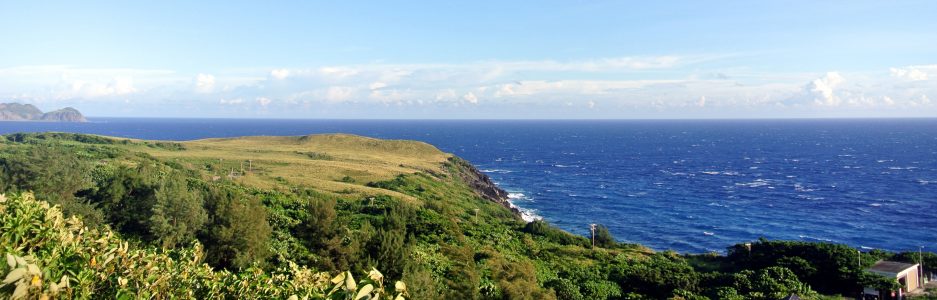
Here, I outline a selection of the evolution and ecology projects that I have led or been involved in throughout my research career, including studies on jewel beetles investigating their visual, thermal, and behavioural adaptations as well as research on Pachyrhynchus weevil defence mechanisms and cuticle properties.
Visual benefits of seeing the far-red
Ultraviolet sensitivity provides important visual contrast for many species, but the advantage of red sensitivity remains unclear. Using modelling and behavioural approaches, I found that the presence of a long-wavelength photoreceptor increases colour contrast between flowers, leaves, and beetles. The results suggest that red sensitivity may enhance visual discrimination of insect colours against vegetation and highlight the adaptive value of long-wavelength sensitivity.
See data visualisation on Github page here. Full text: Insect visual sensitivity to long wavelengths enhances colour contrast of insects against vegetation
The ability to see longer wavelengths enhances the visual contrast perceived by insects between flowers, mates, and leaves
Thermal effect of near infra-red light in jewel beetles
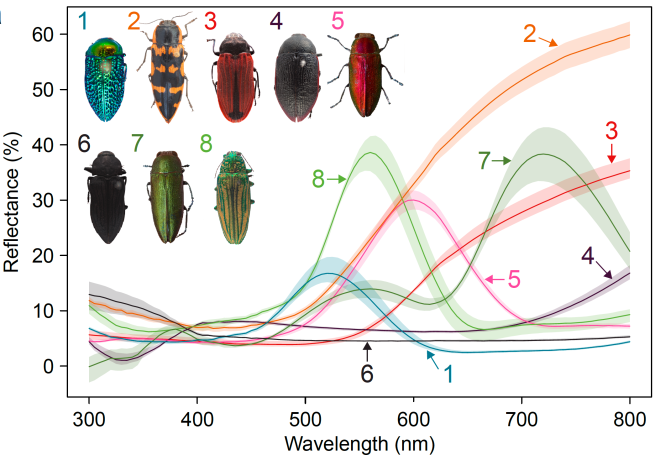
I investigated the thermal effects and evolutionary drivers of near-infrared (NIR) reflectance. Through controlled experiments, I demonstrated that NIR reflectance plays a crucial role in heat transfer. Using a comparative approach and global dataset, I also found that climate is not a strong driver of NIR reflectance variation in jewel beetles, despite its impact on heat transfer.
Full text: (1) Heating rates are more strongly influenced by near-infrared than visible reflectance in beetles; (2) Disentangling thermal from alternative drivers of reflectance in jewel beetles: A macroecological study.
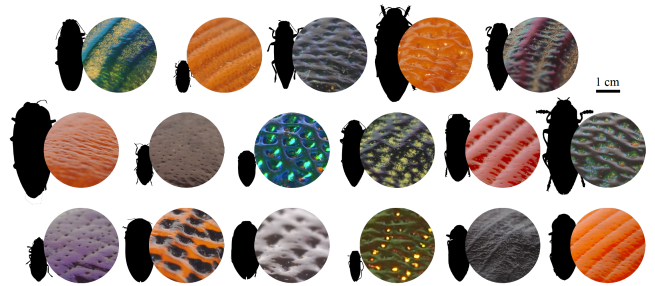
Jewel beetles have high diversity in coloration and surface sculpturing.
Biomechanics of the flicking jewel beetle
In addition to clicking beetles, Astraeus jewel beetles can also launch themselves into the air, but instead of using a click mechanism, they flick themselves by rapidly opening their elytra. I described the kinematics of this ultra-fast movement, proposed a potential underlying mechanism, and demonstrated through behavioural trials that this flicking behaviour may help them escape predators when temperatures are too cold for walking or flying.
The Astraeus jewel beetles flick themselves into the air by opening the elytra ultrafast.
Full text: A new ultrafast movement enables escape at low temperature.
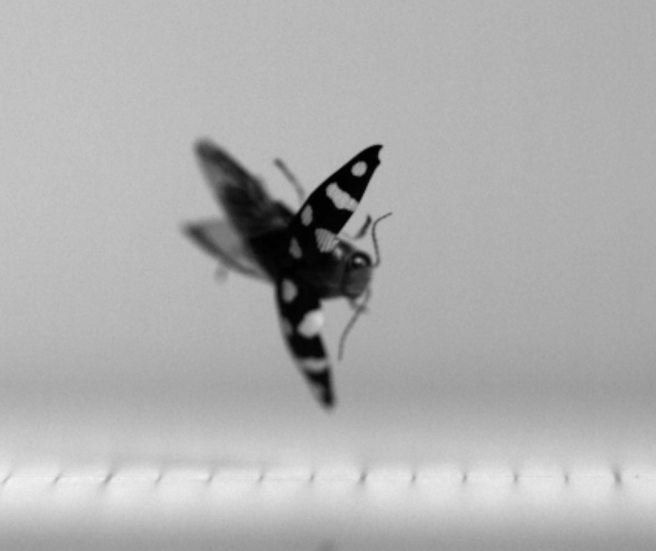
The Astraeus jewel beetles flick themselves into the air by opening the elytra ultrafast.
The secondary defense mechanism of Pachyrhynchus weevils
Aposematic prey are expected to possess effective defences that evolve alongside their warning colours. In this study, I tested the long-standing hypothesis, first proposed by Alfred Russel Wallace, that the hard body of aposematic Pachyrhynchus weevils serves as a defence. Using behavioural trials with lizards as predators, chemical analysis, and rearing weevils from eggs to produce ‘hard’ (mature) and ‘soft’ (teneral) individuals, I found no evidence of chemical repellents. However, while lizards could swallow soft weevils, they immediately spat out hard ones, demonstrating that the extremely hard exoskeleton provides highly effective protection against predation.
Full-text: Too hard to swallow: A secret secondary defence of an aposematic insect; Media coverage: Inside JEB, The Economics
Pachyrhynchus sarcitis defends effectively with its robust exoskeleton against attacks from lizard predators.
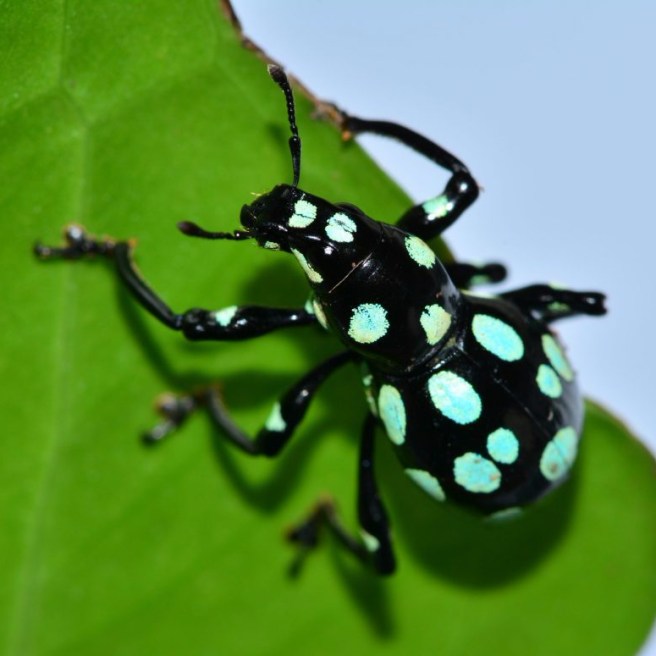
The secondary defence of mature Pachyrhynchus weevils is so effective that lizard predators are unable to consume them. To understand what makes their exoskeleton so robust, I compared the cuticle structure and mechanical properties of mature and teneral weevils using microscopy (confocal laser scanning and cryo-SEM) and measured Young’s modulus. The results showed that mature weevils develop a rigid shell through a combination of structural and material strategies — a thicker, stiffer cuticle and a highly sclerotised endocuticle, a feature not previously reported. Simulations further revealed that fibrous ridges within the endocuticle significantly improve mechanical stability.
Full-text: (1) Biomechanical Strategies Underlying the Robust Body Armour of an Aposematic Weevil; (2) Endocuticle sclerotisation increases mechanical stability of cuticle

The SEM image of a mature weevil’s endocuticle. Fibers are surrounded by fibrous ridges, which have been shown to substantially increased the rigidity of the cuticle from the simulation.
 Lu-Yi Wang